
If you have saved your lolly finding this page - please consider how you can help us?
Look through our Forums - find one that interests you - share your experience with our readers by Joining our community and contributing it. Check out our page on Smart ways to Save Electricity - is there more you could do - something you could share with us or a friend - we do NOT want your cash - we DO ask for your attention!
 If you are a residential rate payer - PLEASE PAY ATTENTION - Your Utility does not charge you for reactive power (pf of less than 100%) and you will save NOTHING - not a penny - no farthings - not a nickel - zilch - I do so hope you believe us!
It is true that most homes have electric motors and other devices which generate reactive power and lower power factor. We know that CFL light bulbs have a Power factor of between 55% and 70%. All electric motors, including fridges, air conditioners, fans and computers generate reactive power which will affect a circuits power factor.
Power factor correction products claim that you will reduce your electricity bill by using capacitors to correct/optimize the power factor of the electricity being used in your home. They further claim that an improved power factor will help electrical motors run more efficiently, extend the life of electrical appliances, save light bulbs and eliminate static interference.
Power factor is a technical term - it relates to the alignment of Volts and Amps - see below for a detailed technical discussion - in simple terms it has NOTHING to do with the power of your electricity - despite the usual meaning of the word power!
I know it sounds logical that power factor correction will save money for home owners. But this is NOT correct at all. Improving a consumers power factor will probably save nothing, and may well cost you money - they do use electricity to charge and discharge their capacitors - and to no purpose for residential users.
Mr Mulvaney, a manufacturer of commercial pf technology contacted me regarding his company and said "I want you to know we do not recommend power factor correction in homes and I will be the first to tell you that savings if any would be negligible".
We suggest that all consumers be vigilant when investigating "var" or KVAR related electricity savings in their home. Call your Utility and ask their opinion - they really will work with you!
Power Factor is one of those subjects about which there seems to be a great deal of confusion and many misconceptions. The culprit is the the assertion that power factor = cos(Phi), Phi being the phase shift between voltage and current. While this is true under certain ideal conditions, there are many real-world instances where it is quite incorrect. This article will give you a basic introduction into power factor, and explain why cos(Phi) is not the whole answer.
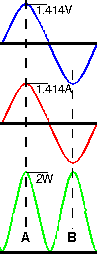 The Basics If you connect a sinusoidal voltage source to a resistor, current will flow, power will be dissipated in the resistor and the resistor will heat up. The current is given by I=V/R and the power is given by P=I*V or P=V²/R. The voltage and current are the rms values.
Figure 1 shows the waveforms for this experiment. The top blue waveform is sinusoidal voltage. The voltage is 1V rms giving a peak voltage of 1.414V, The red waveform is the current. It is 1A rms, 1.414A peak. (If you are awake you will deduce that the resistor is 1 Ohm). The green waveform is the instantaneous power, i.e. the product of voltage and current from moment to moment.
At the left hand vertical line the voltage and current are both at their peaks, so the power instantaneous power is: 1.414V * 1.414A = 2W
At the right hand vertical line we are at the negative peaks of voltage and current, so the instantaneous power is: -1.414V * -1.414A = 2W
It should not take too much imagination to see that the average of the power waveform is 1W.
Please follow this link for the complete article titled Power Factor: Dissipating the Myths published by David Stonier-Gibson of SPLat Controls. We thank him for the permission to publish this introduction!
When the power factor is less than 100% it means that there is a phase shift between voltage and current. Consumer tariffs are based on Real Power, only the electricity actually consumed by a device. The consumer electrical tariffs include provision for the losses which this "phase shift" might cause the electricity supplier.
It is true that electricity suppliers need to manage their distribution networks, and that power factor IS one of the factors that impacts their distribution losses. It is also true that large industrial users are charged a penalty for a net power factor of less than 85%. But distribution losses will not be solved by consumers. They are aggregate issues that can only be solved by the utility companies "the smart grid" in partnership with industry and device manufacturers.
Power factor and power factor correction are indeed subjects that we should be aware of, but it is "near fraud" when excessively marketed to home owners as a way to save money on their electricity bill.
We have an overview on Power Factor and the definitions for real power, apparent power and reactive power for those who would like to understand more of the technical details on this topic.
If you are uncertain as to the accuracy of open4energy's opinion we suggest you review this study by ScienceDaily - (Dec. 18, 2009) - "If you've seen an Internet ad for capacitor-type power factor correction devices, you might be led to believe that using one can save you money on your residential electricity bill. However, a team including specialists at the National Institute of Standards and Technology (NIST) have recently explained why the devices actually provide no savings by discussing the underlying physics".
Open4Energy - Get Smart about Energy™
Publishing two Expert Opinions
“The internal energy losses in the power factor correction capacitor(s) and wiring may offset or exceed any external energy savings in the home or business.” Charles Middelton, PG&E Engineer.
"Many people might not realise that this could cost quite a lot if you do hang capacitors across the mains with the intention of 'improving' your power factor. As pointed out above, the domestic consumer (in the UK at least) pays for real power, there is no cost and no penalty for taking reactive (virtual) power. But the system is generally inductive, adding capacitors will tend to set up a resonant circuit and increase the system voltage, which could reduce the life of each and every appliance connected." R Wall, B.Sc., C.Eng., MIEE